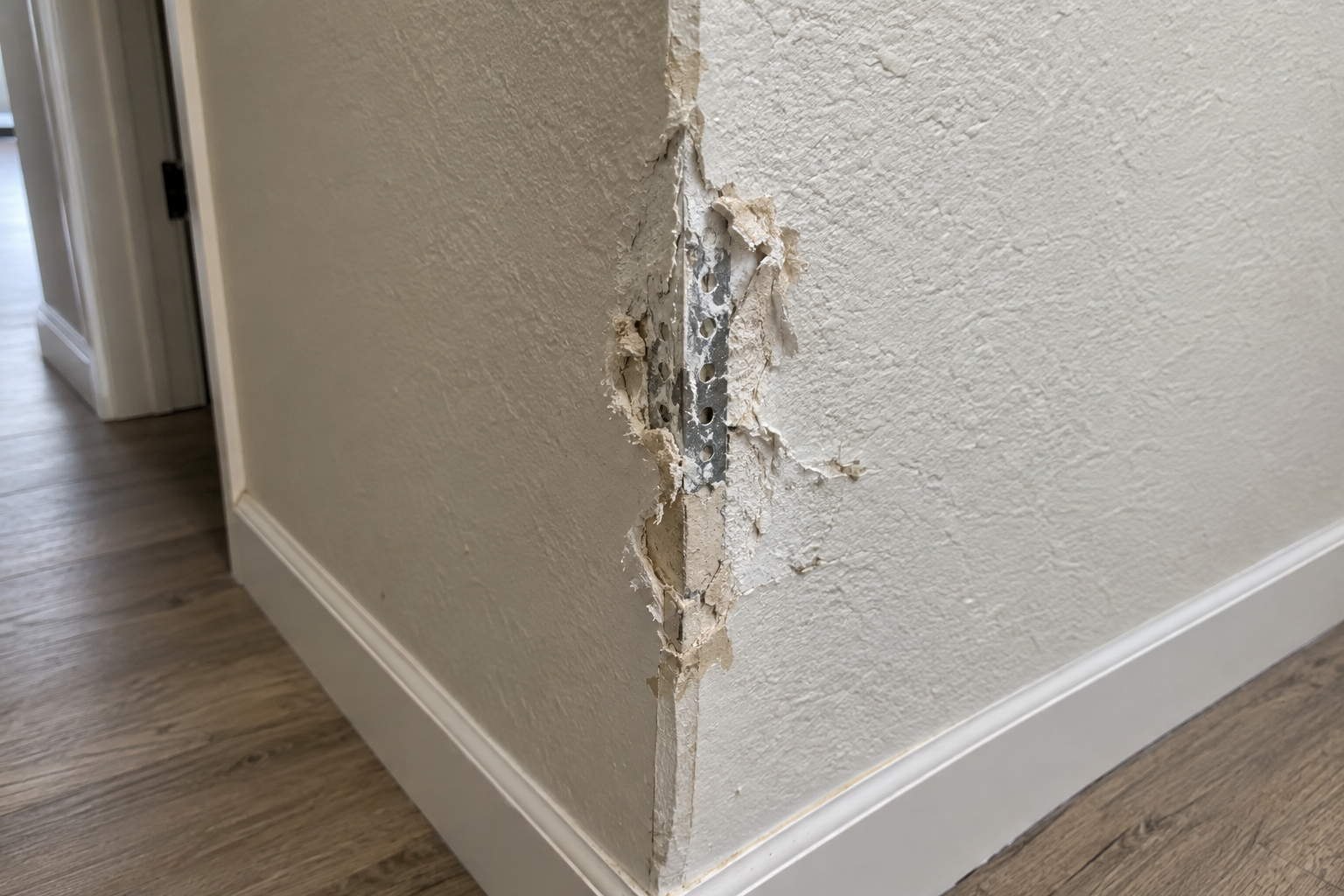
Most people who ring us about a visible patch describe it the same way. The repair was done, it was sanded flat, it was primed and painted, and you can still see exactly where it is. They assume something went wrong with the mud.
Usually nothing went wrong with the mud. The flat work was fine. What is showing is that the surface texture inside the repair is not the same as the surface texture around it, and paint does not hide that. Paint is a film a few thousandths of an inch thick that copies whatever shape is underneath it. If anything, a uniform coat of paint makes the difference easier to see, because it removes colour variation and leaves nothing but shape and shadow for your eye to work with.
What You Are Actually Looking At
An orange peel wall is not rough. Run your hand over one and it feels barely textured. What it has is a field of very small rounded peaks, thousands of them per square foot, each one a droplet of thinned joint compound that hit the wall, flowed slightly and set.
When light arrives at that wall from an angle, every peak casts a shadow on the low ground behind it. From a distance you do not perceive individual shadows, you perceive an even, slightly muted, slightly grainy surface. That perception is remarkably consistent, which is exactly the problem: your eye has calibrated itself on the whole wall, and it will flag any area whose shadow density differs from that baseline.
A smooth patch throws no shadows at all and reads as a bright flat ghost. A patch textured too finely throws shorter shadows and reads slightly lighter. A patch textured too coarsely reads darker and slightly rougher. All three are visible, and the coarse one is the one people are most surprised by, because it feels like erring on the safe side.
Riverside Makes It Worse
Two local conditions turn a marginal texture match into an obvious one.
The first is light. This valley gets long stretches of clear afternoon sun, and a west facing window in a Riverside living room delivers hard direct light at a very shallow angle to the adjoining walls for hours. Light at a shallow angle to a surface is called raking light and it is the standard way any finisher inspects work, because it maximises the length of every shadow. Homes here get a free raking light inspection every clear afternoon, whether anyone wants one or not.
The second is the housing stock. A great deal of Riverside is slab on grade tract building where a single crew sprayed every wall in the house in one or two passes. The texture is therefore extremely uniform across the whole property. Uniformity is what gives a mismatch something to be compared against. In an older Wood Streets house with layers of different work over the decades, or a wall carrying a hand applied pattern, a slightly off patch has a chance of disappearing into the general variation. In a tract house it has nowhere to hide.
Orange Peel, and the Two Dials
Orange peel comes off a hopper gun. Joint compound is thinned with water to somewhere around the consistency of thick paint, loaded into the hopper, and pushed through a nozzle by compressed air.
There are two things you can change and they interact.
Particle size is set by the nozzle orifice and the mix consistency. A bigger orifice and thicker mud throw larger droplets. A smaller orifice and thinner mud throw finer ones.
Air pressure atomises. More pressure breaks the stream into smaller particles and spreads them further; less pressure produces bigger blobs in a tighter pattern.
A third factor, distance from the wall, is often treated as a dial but should not be. Droplets lose energy and dry slightly in transit, so spraying from further back gives you a finer, drier looking texture and less flow after landing. It works, but it is unrepeatable by hand, and if you match a wall by standing at a particular distance you cannot reproduce that match the following week. Fix the distance, use the other two dials, and you get a setup you can write down.
There is one more variable that costs people a lot of time and it is not on the gun at all. Coverage density. Two passes at 40 percent coverage each do not look like one pass at 80 percent, because the second pass lands droplets on top of dried droplets and builds a different profile. On an existing wall you are usually matching a single pass, so match with a single pass.
Knockdown Is a Timing Problem
Knockdown begins as orange peel sprayed heavier, with larger droplets and higher coverage. Then it is left alone. Then it is flattened with a wide blade, usually an eighteen inch flexible knockdown knife, in a light pass that squashes the tops of the wet droplets without dragging them.
Everything about the finished appearance lives in how long you wait.
Flatten too early and the mud is still fluid. The blade smears it rather than flattening it, and you get long directional streaks instead of discrete islands.
Flatten too late and the surface has skinned properly. The blade tears the tops off instead of squashing them, which leaves a ragged edge and often pulls material away entirely.
In the window between, the droplet has a firm skin and a soft interior, and the blade flattens it into a smooth island with a defined edge. Wait toward the early end of the window and the islands come out wide, flat and heavily overlapped. Wait toward the late end and they stay smaller, tighter and more separated.
So when you look at an existing knockdown wall and see wide flat islands, you are looking at the record of a decision somebody made years ago about when to pick up the knife. Matching that pattern means reverse engineering their timing, and the only way to do it is to test.
The window itself is short here. Dry inland air pulls water out of thinned compound quickly, and on a hot afternoon in a room with no air conditioning running you may have two or three minutes rather than the ten a general instruction sheet suggests. That is a practical reason to work in small sections. Spraying a whole ceiling and then starting the flattening pass at one end means the far end is well outside the window by the time you reach it, and the two halves of that ceiling will not match each other, never mind the patch.
The Test Board
This is the entire method and it is not complicated. It is just a step people skip.
Take a scrap of drywall roughly two feet square. Prime it, because primed board absorbs water out of the texture at a rate closer to a painted wall than raw paper does, and absorption affects how the droplet settles.
Mix your compound, set your pressure, and spray a section of the board. If you are matching knockdown, time the wait with an actual clock rather than a feeling, and flatten it. Write the settings and the timing directly on the back of the board in pencil.
Let it dry completely. This part gets rushed and it should not. Wet texture sits flatter, reads darker and looks finer than the same texture will look dry. Judging a match on wet mud is how you end up with a patch that is a step coarser than the wall.
Then take the dry board to the wall, hold it flat against the surface, and look at the join in the light that room actually gets at its worst hour. In a west facing room that means the afternoon. Not a work light aimed straight at the wall, which flattens everything and will tell you a bad match is fine.
If it is off, change one thing, spray another section, and label it. Three or four sections on one board is normal. Two boards is not unusual on knockdown.
When the Honest Answer Is Retexture the Wall
Some patterns will not blend and it is better to know that at the start.
Heavy old knockdown with very wide islands, hand applied trowel and skip trowel finishes, anything with a directional or repeating character, and old ceilings sprayed with equipment nobody uses now all fall into this group. You can get close on a test board and still see the repair on the wall, because a blend has an edge, and an edge in a regular pattern is exactly what the eye is good at finding.
The fix is to skim the patch flat and retexture the surface from inside corner to inside corner. No blend, no edge, nothing to find. It costs more than a patch and less than living with a repair you notice daily.
After the Texture
Repaint corner to corner on that wall. Even with a perfect texture match, fresh compound and primer take colour differently to a wall that has been painted for twenty years and has faded unevenly under that same afternoon sun. Cutting the paint in mid wall replaces the texture edge you just eliminated with a colour edge.
If the wall is a colour nobody has a record of, and matching paint is going to be its own project, factor that in before deciding where the repair stops. Sometimes the sensible scope is the whole room.
The Short Version
The mud work is the visible half of a drywall repair and the easy half. The texture is the half that decides whether anybody ever notices the patch again. Identify what is on the wall, use a fixed spraying distance and change only pressure and mix, time your knockdown with a clock, test on primed board, dry it before you judge it, and check the match in raking light rather than under a work lamp.
If any of that sounds like more trouble than the repair is worth, that is a fair conclusion for a ding behind a door in a dark hallway. For a wall you look at every afternoon, it is the difference between a repair and a permanent reminder.
Chicagopetshow patches drywall and matches texture across Riverside. Call (951) 515-1943, or send a photo taken with a phone light held flat against the wall so it rakes across the surface.